

TalentReef – AI-Assisted Applicant Review
Designing the interface layer between AI-generated candidate intelligence and the hiring managers who need to act on it — focused on trust, transparency and decision confidence.

TalentReef – AI-Assisted Applicant Review
Senior Product Designer
Mitratech
AI-Assisted Decision Workflows
Recruiters & Hiring Managers
Quick Story
TalentReef was exploring AI integration in the applicant review experience.
Before designing anything, I needed to understand two things: what hiring managers actually needed from AI — and how they were currently navigating the review experience in the existing product.
The current ATS design had a drawer-based applicant view with multiple tabs — Overview, History, Applications, and others. Managers were navigating back and forth between tabs to piece together key information about each applicant.
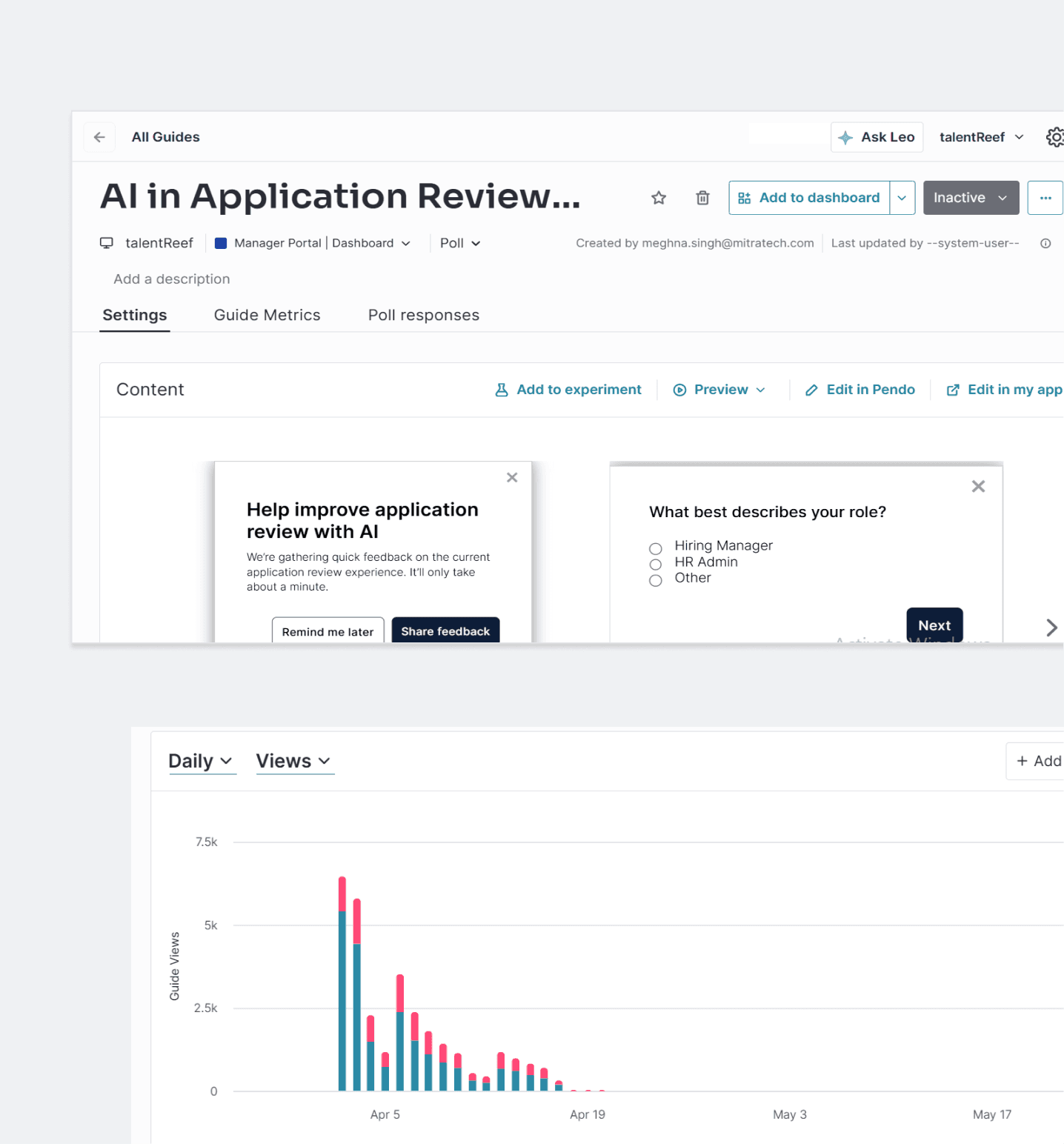
I ran a Pendo Poll to hear it directly from users. Then I analysed Pendo Session Replays to watch how managers were actually behaving inside the product.
What emerged was a clear and consistent pattern.
The problem wasn't missing AI features.
It was fragmented information — and the back-and-forth it forced on every single review.
That insight told me exactly where AI belonged and why.
Context
TalentReef serves restaurant and retail organisations managing high-volume hiring — often hundreds of applications per role across multiple locations.
Hiring Managers in these environments move fast. They review large volumes of applicants daily and need to make quick, confident decisions about who to progress.
The existing applicant review experience opened a drawer when a manager clicked on any applicant from the list view. Inside the drawer — multiple tabs: Overview, History, Applications and more.
Key information about each applicant was distributed across those tabs. Getting a complete picture meant navigating back and forth — repeatedly, for every applicant reviewed.
The Problem
The applicant review process in TalentReef required hiring managers to navigate across multiple tabs to gather key information about a single applicant.
There was no consolidated view. No single place where the most important signals about an applicant were visible at once.
This created a consistent friction pattern: managers were spending time navigating rather than deciding.
Before AI could help, the experience needed to consolidate. AI integration without solving that underlying problem would add another layer — not reduce one.
Research validated placement
Pendo Poll + Session Replay synthesis presented and approved
Behavioural pattern confirmed
tab-switching during applicant review validated across multiple session replays
AI integration direction established
Overview tab, open by default, key info consolidated

Process
Research & Discovery: I used two research methods in combination — one to capture user perception, one to capture user behaviour.
Pendo Poll — capturing what users needed
I designed and launched a targeted Pendo Poll to the relevant hiring manager and HR Admin segment on the TalentReef Manager Portal Dashboard.
The open-text responses surfaced a consistent theme across users: the need to get key information about an applicant in one place rather than navigating back and forth across tabs.
Users weren't asking for AI. They were asking for consolidation.
Pendo Session Replays — validating behaviour
To validate the pattern behaviourally, I analysed Pendo Session Replays of hiring managers navigating the applicant review experience in the existing product.
The replays confirmed what the Poll surfaced — managers were consistently switching between tabs during each applicant review. The navigation pattern was repetitive and fragmented.
The two methods together gave me what I needed: a validated placement rationale grounded in both what users said and what users did.
Synthesis and PM alignment
I synthesised both research streams and presented findings to the PM. The direction was clear:
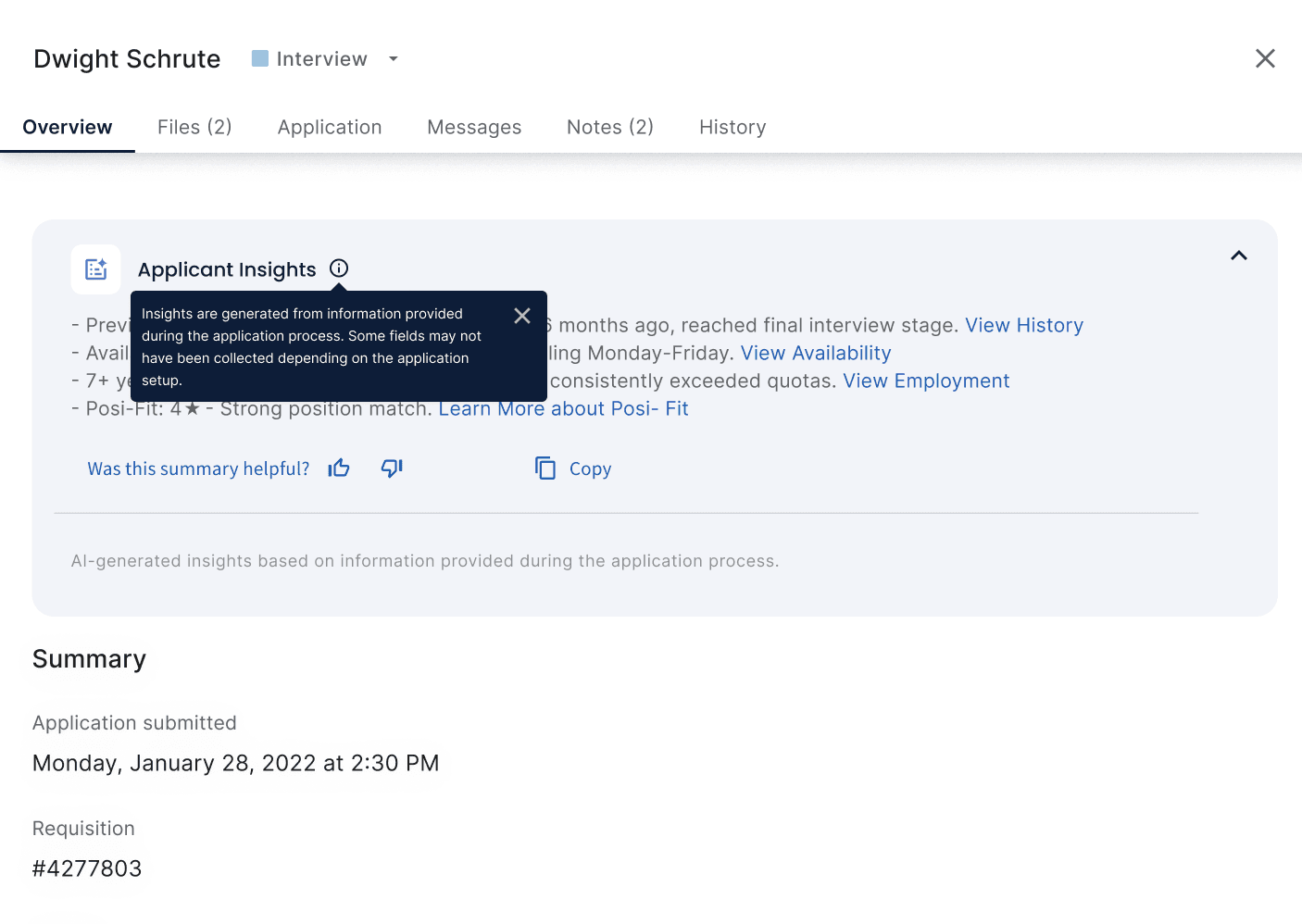
The Overview tab — the first tab visible when the drawer opens — was the right place for an AI Insight panel. It's where the manager lands first. It's where a consolidated summary would have the most immediate impact.
The panel would be open by default. No extra click. No additional navigation.
Key Insight: "Users weren't asking for AI. They were asking for consolidation. AI was the solution — but only once we understood the actual problem."
Design Thinking:
Research before assumption — understand existing behaviour before designing AI integration
Consolidation over addition — solve fragmentation first, then layer AI on top
Placement is a design decision — where AI lives in the UI determines whether it gets used
Default open — reduce friction to zero for the highest-value panel
Behavioural validation — what users say and what users do must both be understood
Design Decisions:
Decision 1 — AI Insight panel in the Overview tab: Placed the AI-generated applicant summary in the Overview tab — the first tab visible when the drawer opens. Grounded in both Poll responses and Session Replay analysis showing this as the natural landing point for every review.
Decision 2 — Open by default: The AI Insight panel opens by default — no additional click or interaction required. Removes friction from the highest-value moment in the review flow.
Decision 3 — Consolidated key information: The panel surfaces key applicant signals in one place — directly addressing the core user need identified in the Pendo Poll: get the most important information without navigating across tabs.
Decision 4 — Validated placement through research: Placement decision was grounded in two data sources — Pendo Poll open-text responses and Session Replay behavioural patterns — presented to and approved by PM before design finalisation.






"The most important design decision on this project wasn't where to put the AI panel. It was deciding to understand user behaviour before deciding where to put it. The placement answer came from the research — not the other way around."


Solution Summary
Pendo Poll designed and launched to targeted hiring manager segment
Session Replay analysis conducted to validate navigation behaviour patterns
Research synthesis presented to PM — direction confirmed
AI Insight summary panel designed for Overview tab — open by default
Placement grounded in both attitudinal and behavioural research
Design concepts approved for development direction
Additional outcomes:
Two research methods used in combination for the first time at Mitratech for AI feature validation
Clear design principle established — consolidate before adding AI, not alongside it
Pendo used for both attitudinal research (Poll) and behavioural research (Session Replays) on the same feature
What I'd Do Next:Run usability testing with real hiring managers on the AI Insight panel — does default-open feel helpful or intrusive?
Instrument Session Replays post-launch to measure whether tab-switching behaviour reduces
Track engagement rate on the AI panel — are managers reading it before making decisions?
View All Work